
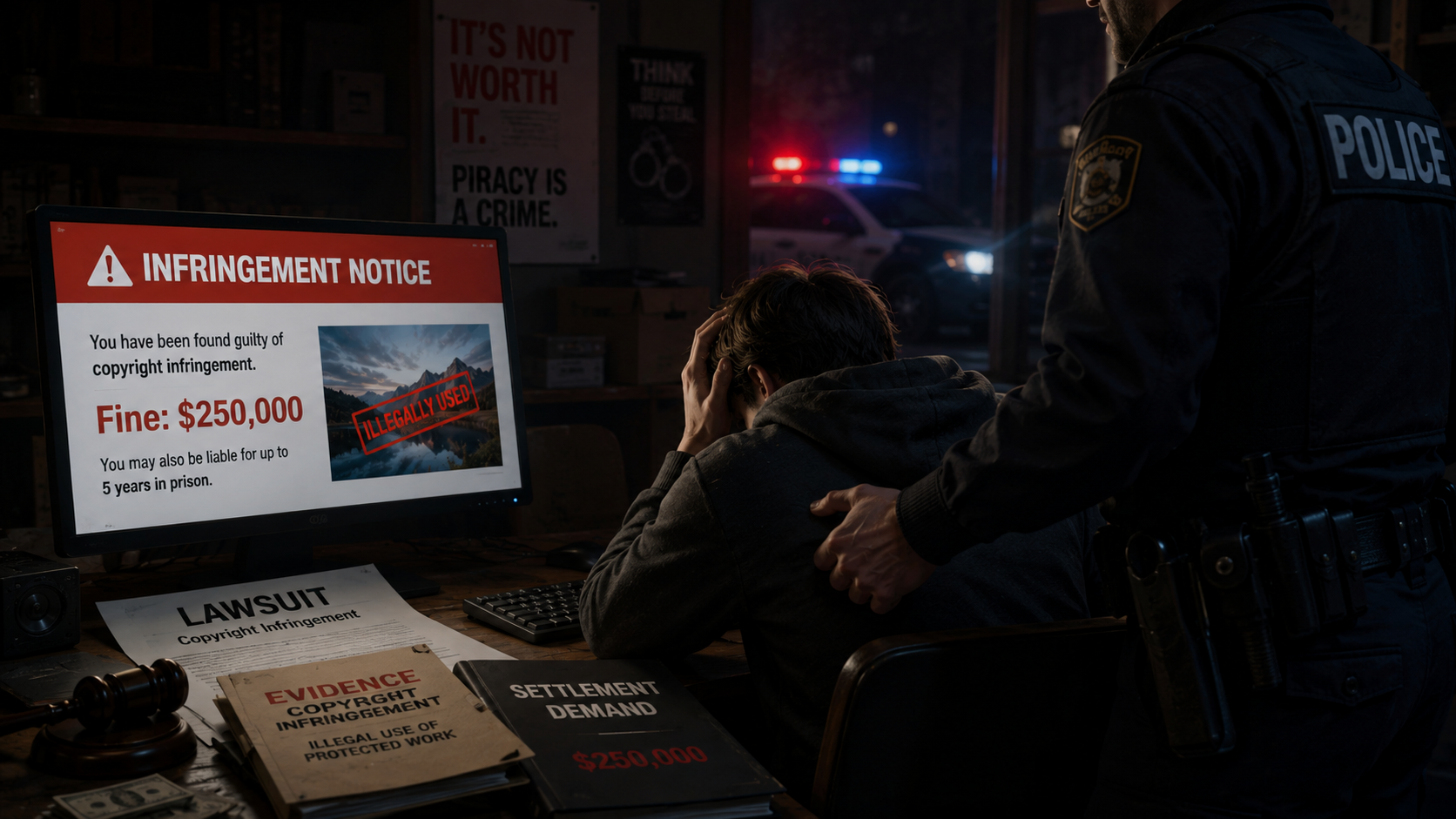
It starts the same way every time. A business owner builds a website, launches a blog, or schedules a social post — and needs an image. They search Google, find something that looks perfect, right-click, and download it. Three months later, a letter arrives from an attorney. Here is what happens next, and how to make sure it never happens to you.
The call comes in on a Tuesday. A small equestrian boutique — one that had been in business for eleven years — received a cease and desist letter from a legal firm representing a commercial photography agency. The boutique’s website had used three photographs. Not prominently. Not intentionally stolen — the previous web designer had pulled them from a Google image search years earlier, and no one had thought twice about it.
The demand: $2,750 per image. Total exposure: $8,250. Plus attorney’s fees if they didn’t settle within thirty days.
They paid.
This is not a horror story about bad luck. It is an increasingly common outcome for businesses of all sizes — from solo operators to mid-market brands — who treat images on the internet as if they exist in a public commons. They do not. Every photograph, illustration, and graphic you encounter online belongs to someone. That someone has legal tools to find you, identify your usage, and extract compensation — and in many cases, they are actively using those tools.
If your website, social channels, email campaigns, or blog posts contain images you did not create yourself or explicitly license, you are exposed. This article explains what that exposure looks like, how enforcement actually works, and what you need to do differently starting today.
The Legal Framework
Copyright protection is automatic — and so is your liability
Here is the first thing most business owners get wrong: they believe copyright infringement requires intentional theft. It does not. The moment a photographer presses a shutter, a graphic designer exports a file, or an illustrator finishes a piece, that work is protected by copyright under U.S. law — automatically, without registration, without a copyright symbol, and without any notice to you.
If you use that work without authorization, you have infringed — regardless of whether you knew who owned it, whether the image appeared on a free-looking website, or whether you’ve been using it for years without incident. Intent is not a defense. It is, at most, a factor that influences how much you pay.
Under Section 504 of the U.S. Copyright Act, a copyright owner whose work has been registered prior to infringement — or within three months of publication — can elect to pursue statutory damages rather than proving actual financial loss. This distinction matters enormously.
Statutory damages exist precisely so rights holders don’t have to document every dollar of harm. The law simply sets a range, and a judge or jury assigns a number within it.
Innocent Infringement
$200
Per image, minimum — only if you can prove you had no reason to believe you were infringing
Standard Infringement
$750–$30,000
Per image — court’s discretion based on severity and the infringer’s financial capacity
Willful Infringement
Up to $150,000
Per image — when the court finds the infringement was intentional or reckless
That last number bears repeating. A single photograph, used willfully — which courts can interpret as continuing to use an image after receiving a takedown notice — carries a maximum statutory exposure of $150,000. Now multiply that by the number of images on your website.
A 2023 case, Scott Hargis v. Pacifica Senior Living Management LLC, resulted in a $6.3 million verdict — $150,000 awarded for each of 43 photographs a senior living company had used on its marketing materials without license. The court found willful infringement. The company had been notified. They did not act quickly enough.
How They Find You
Image enforcement is now largely automated — and highly effective
A persistent myth among business owners is that infringement only matters when you’re large enough to be worth pursuing. This was partially true twenty years ago, when enforcement required a rights holder to manually locate infringing usage across the web — an impractical task at scale.
That era is over.
Reverse image search technology — pioneered by Google and now embedded in countless commercial enforcement platforms — allows rights holders and the agencies that represent them to scan billions of web pages and identify unauthorized use of a specific image within minutes. Companies like Getty Images, Shutterstock, and Alamy, as well as independent photographers represented by licensing enforcement firms, use these tools as a matter of routine business.
Getty Images alone has been sending demand letters to businesses for years, typically demanding between $1,000 and $2,750 per image when unlicensed usage is detected. Their process is systematic: automated scanning identifies the infringement, a demand letter is generated, and the business receives a notice with a settlement deadline. Removing the image after receiving the letter does not eliminate the liability — you infringed during the period it was live, and that exposure remains.
Real-World Scenario
A marketing coordinator updates a company blog. She searches Google Images for a photo of a horse at a competition, finds one that looks editorial, and uploads it. The photo was taken by a professional equestrian photographer who registered the image with the U.S. Copyright Office and licenses enforcement to a third-party firm. Their crawler identifies the usage within 60 days. A demand letter arrives for $1,500. The company’s attorney advises settling. Total cost: $1,500 in settlement, $750 in legal fees, and a scramble to audit every image across the entire site.
Beyond large stock agencies, individual photographers — particularly in niche industries like equestrian sport, luxury lifestyle, and real estate — are increasingly aware of their rights and aggressive in enforcing them. A single equestrian photographer whose work appears on a tack shop’s website without license has a valid claim. A luxury brand that uses a lifestyle image pulled from Instagram without explicit written permission from the creator is exposed. The niche nature of your industry does not insulate you — it often makes the pool of rights holders more identifiable and more engaged.
The Most Dangerous Misconceptions
What business owners get wrong — and pay for
Misconception 1: “It was on Google Images, so it must be free to use.”
Google Images is a search engine. It indexes images from across the internet regardless of their copyright status. The presence of an image in search results conveys no license whatsoever. “Available to view” and “licensed for commercial use” are entirely different things, and Google’s own usage rights filter — which many users ignore — exists precisely because the distinction is legally significant.
Misconception 2: “I gave the photographer credit, so I’m covered.”
Attribution is not a substitute for licensing. Giving credit to the creator is a courteous and ethical practice, but it does not grant you permission to use the work. A copyright owner can credit an infringer with accurate attribution and still pursue full statutory damages — attribution addresses moral rights and academic integrity, not commercial licensing.
Misconception 3: “It was already on our site for years, so nothing will happen.”
The statute of limitations for copyright infringement in the United States is three years from the point at which the plaintiff discovered or should have discovered the infringement. A 2024 U.S. Supreme Court ruling confirmed that copyright plaintiffs can pursue damages for infringement that began outside the three-year window, provided they were unaware of it — meaning longstanding infringement is not necessarily safe from legal action. The longer an unauthorized image has been live on your site, the more time it has been accruing infringement liability.
Misconception 4: “The image didn’t have a watermark, so it wasn’t protected.”
Watermarks are a practical business decision made by some rights holders. Their absence means nothing legally. Copyright exists from the moment of creation and attaches to any original photographic work regardless of whether it carries visible marking. An unmarked image pulled from an online portfolio, a social media post, or an editorial feature is fully protected.
Misconception 5: “I just deleted it, so the problem is solved.”
Removing an infringing image stops future infringement from accumulating, but it does not erase past liability. The rights holder retains the ability to pursue damages for the entire period the image was in use. Taking it down quickly after receiving a demand letter is advisable — but it is the beginning of resolving the situation, not the end of it.
Misconception 6: “My web designer handled all of that.”
Unless your agreement with a web designer contains explicit warranties that all images used are properly licensed — and assigns liability for any claims arising from unlicensed usage — that is not a defense you can rely on. The business that publishes the website is the entity with public-facing exposure. You may have a separate claim against a contractor who sourced images improperly, but that is a different conversation that does not protect you from the rights holder’s initial claim.
High-Risk Surfaces
Where infringing images most commonly appear in brand marketing
Copyright infringement is not limited to websites. Every digital surface your brand occupies carries the same exposure — and some are particularly high-risk because they are often managed quickly, by multiple people, without formal review.
- Website imagery — hero images, blog post thumbnails, product photography used to represent a brand or category, team pages using images sourced from Google rather than taken on-site
- Social media posts — Instagram, Facebook, and LinkedIn content that uses photographs pulled from the web, other accounts, or editorial sources without explicit permission from the creator
- Email marketing — campaign imagery sourced from searches rather than owned photography or properly licensed stock
- Blog and editorial content — a high-frequency surface where images are often chosen hastily, with “good enough” sourcing rather than verified licensing
- Paid advertising — Meta and Google ads that use unlicensed photography compound exposure because they are distributed at commercial scale, which courts may treat as aggravating willfulness
- Printed materials — brochures, event programs, and signage sourced from digital assets that were never properly licensed in the first place
- Press releases and media kits — often assembled under deadline, with images pulled from existing files whose licensing status is unclear or undocumented
The Right Framework
How to build an image practice that eliminates the risk entirely
The good news is that this is a solvable problem. Copyright infringement arising from image usage is one of the most preventable legal risks a business faces — because the right practices are not expensive, and they are not complicated. They simply require consistency.
1. Commission original photography
The single most effective solution — and the one that simultaneously builds brand equity — is investing in original photography. Images you commission and own cannot infringe on anyone’s rights. They are also differentiated, on-brand, and impossible for a competitor to replicate. For brands in equestrian, luxury lifestyle, and elite sport, original photography is not a luxury item. It is a foundational brand asset.
2. License stock photography properly
When original photography is not feasible for every use case, use reputable stock platforms — Getty Images, Shutterstock, Adobe Stock, or Unsplash for certain use cases — and purchase the correct license for your intended usage. A standard license for website use is different from a license covering paid advertising. Read the terms. Keep the receipts. The documentation that you licensed an image is your protection if a claim ever arises.
3. Understand the difference between “free” and “licensed for commercial use”
Some images genuinely are free to use commercially, licensed under Creative Commons Attribution or similar terms. But those licenses often require attribution, restrict commercial use, or prohibit modification — and violating their specific terms still constitutes infringement. When using Creative Commons imagery, read the license type carefully and document your compliance. Screenshot the license, the source page, and the date of access.
4. Audit your existing digital presence
Before you receive a demand letter, conduct a systematic review of every image currently in use across your website, social profiles, blog archive, and email templates. For each image, confirm that you have documentation of either original creation or explicit licensing. Any image you cannot verify should be removed and replaced.
5. Establish a formal image sourcing policy
Anyone who contributes to your marketing — internal team members, contractors, agency partners — should operate under a written policy that defines approved image sources and prohibits any unauthorized usage. This includes social media coordinators scheduling posts, copywriters dropping images into blog templates, and paid media managers pulling creative assets. The chain of accountability needs to extend to every person who touches a published surface.
- Define a list of approved image sources (stock platforms you hold active licenses with, your owned photography library)
- Require documentation for every image used — license confirmation or photographer agreement
- Designate a single point of accountability for image approval before publication
- Audit your image library quarterly and remove anything without verified licensing
- When engaging a web designer or marketing agency, require explicit contractual warranties that all delivered assets are properly licensed
- When receiving imagery from clients, vendors, or event organizers, confirm in writing that the images are licensed for your intended commercial use
6. When in doubt, don’t use it
This sounds simple because it is. If you cannot confirm the licensing status of an image — if you don’t know where it came from, who owns it, or under what terms it may be used — do not publish it. The cost of sourcing a replacement image is always lower than the cost of defending an infringement claim, even one that ultimately settles for a modest amount.
The Business Case
This is not just a legal issue — it is a brand issue
There is a dimension to image copyright that extends beyond legal liability, and it matters particularly for brands in premium and luxury categories: the people whose images you might inadvertently infringe on are often the same people whose respect you need.
In equestrian sport, professional photographers are embedded in the same show circuit you move through. Luxury lifestyle photographers work with the same publications and brands you are trying to reach. Using someone’s work without permission — even without intent — is a reputational event when it comes to light. The equestrian world in particular operates on a tight social network where those kinds of stories travel.
Beyond the relational dimension, building a library of original, properly licensed photography is a compound investment. Every image you commission is an asset that works across channels, cannot be used by competitors, and contributes to a visual identity that is coherent and defensible. Brands that invest in original creative work look different from those that source imagery reactively — and at the premium end of the market, that difference is visible immediately.
At NewStyle Digital, every client engagement we take on includes a review of existing digital assets — including imagery. It is one of the first things we look at, because we have seen firsthand what a preventable oversight can cost. Our creative production work exists in part to give clients a library of original photography that eliminates the risk entirely while building the kind of visual brand that earns attention in premium markets.
If you have questions about your current exposure, or you are ready to build a content strategy grounded in owned creative assets, the conversation starts here.